
Searching Quitman County Civil Dockets
Chancery Court is the first stop for many Quitman County civil matters. The official Seventh Chancery CourtInfo page identifies Quitman's participating Chancery court. Its civil docket covers divorce, custody, support, paternity, and estates. Guardianships, conservatorships, trusts, land, equity, and related proceedings appear there too. Circuit Court takes larger general civil litigation. Justice Court handles limited civil claims. The word civil alone will not pick the right docket. The subject of the dispute points the way. So does the court named on any notice you received.
Electronic court records for participating courts sit behind MEC and PAMEC. Both need an account first. When an online docket search comes up short, the Chancery Clerk is the fallback. It covers older files, restricted records, and certified copies. After you log in, work with the search fields the system actually offers. Do not assume a case-number pattern or menu that a court has never promised.
- Identify the subject and court named on the summons, order, or other case paper.
- Use the Seventh Chancery MEC/PAMEC route for a participating Chancery matter.
- Search with the available authenticated method and compare court, case number, caption, and filing date.
- Read the public docket sheet for dated filings, settings, and orders.
- Ask the Chancery Clerk about access, redaction, or certification when a needed document is not available remotely.
Quitman County Civil Docket Court Choice
Quitman County's court map has several civil doors. Chancery is the likely home for domestic relations, probate, guardianship, trust, land, and equity matters. Circuit Court serves as the general-jurisdiction path for larger civil actions. It also takes anything Mississippi law assigns there. Justice Court handles limited claims. Living inside a city does not route a civil case through a municipal office. That office is no substitute for the county court routes.
| Subject | Likely first court route | Search caution |
|---|---|---|
| Divorce, custody, support, or paternity | Chancery Court | Children and family filings can be restricted even when a header is public. |
| Estate, trust, guardianship, or conservatorship | Chancery Court | Ask about protected financial or personal material. |
| Land or equity matter | Chancery Court | Confirm whether the request is for a court pleading or a separate land instrument. |
| Larger general civil action | Circuit Court | Use the Circuit route, not the Chancery docket, when the filing belongs there. |
| Limited civil claim | Justice Court | No official public Quitman Justice Court search was located. |
Mixed issues can muddy the routing. The right clerk can tell you which court keeps the file without touching the legal merits of the dispute.
Inside a Quitman County Civil Docket
Think of a Quitman County civil docket sheet as a dated register of case activity. It may list the court, case number, and parties or caption where public. Filings, motions, settings, and orders may appear. A final judgment or dismissal may show too. An electronic view is not always a full file. It is not a certified court record either. The field labels and search screens vary from system to system. Treat any on-screen layout as something to verify rather than assume.
| Court and case number | Shows which court holds the case and helps distinguish a similar name or related matter. |
|---|---|
| Parties or caption | May identify the case parties where public, subject to privacy and access limits. |
| Filings and motions | Records pleadings, requests, responses, and court action where the docket makes them public. |
| Settings | Shows a scheduled event or court date. A setting is not a disposition. |
| Orders or judgment | May show an entered order, judgment, dismissal, or other recorded action, but access to the document can vary. |
Ask for a document by name and date when you can. A clerk handles that far better than a broad request for every record tied to a case.
Quitman County Chancery Docket Flags
Seventh Chancery CourtInfo uses system flags. The list runs long: GAL, GAL_1k, Minor_Child, DHS, TRUST, INVENTORY WAIVED, ACCOUNTING WAIVED, EX PARTE, INTERPRETER, and SEALED. The vocabulary helps you frame the procedural question worth asking. It proves nothing private about a person. It grants no right to a filing either. Docket entries, court orders, and the clerk remain the proper sources for record context.
- GAL
- A guardian ad litem-related marker. It does not reveal the reason for appointment or the content of protected filings.
- Minor_Child
- A system label that signals special privacy care. Public availability can be narrower than the case header suggests.
- TRUST
- A category marker that should be read with the docket and order, not as a full description of the matter.
- SEALED
- An access boundary. It changes what may be viewed or copied and does not by itself explain the case.
A visible header is not an open attachment. Child, medical, financial, guardianship, and sealed material can stay restricted even when the case number and basic docket information are public.
Civil Case Types on the Docket
Chancery and Circuit civil dockets are not interchangeable. The strongest Chancery categories in Quitman County are domestic relations, probate, guardianship, conservatorship, trust, land, and equity matters. Circuit can hold larger general civil litigation. Justice Court plays a limited civil role. Sort out the court and subject matter before you type a party name into any docket search.
- Divorce, custody, child support, and paternity matters commonly routed to Chancery.
- Estates, guardianships, conservatorships, and trusts commonly routed to Chancery.
- Land and equity proceedings routed through Chancery when they are court cases.
- Larger general civil actions that belong in Circuit Court.
- Limited civil claims that may be handled in Justice Court.
That list routes records. It does not decide jurisdiction for a new filing. A clerk can point to the right office, while legal advice belongs with a qualified legal professional.
Quitman County Chancery Docket History
Quitman County Chancery Court belongs to the Seventh Chancery District. CourtInfo lists its MEC go-live date as February 13, 2017. That date explains a lot. Older Quitman County court records may sit on paper. Some exist only as scans. Others carry a different index, or appear only partly through MEC. A remote no-result on a docket search never proves an older case failed to exist. The Seventh Chancery MEC login boundary shows the court-specific electronic route for participating records. It shows where authenticated access begins and how its court docket history is presented.
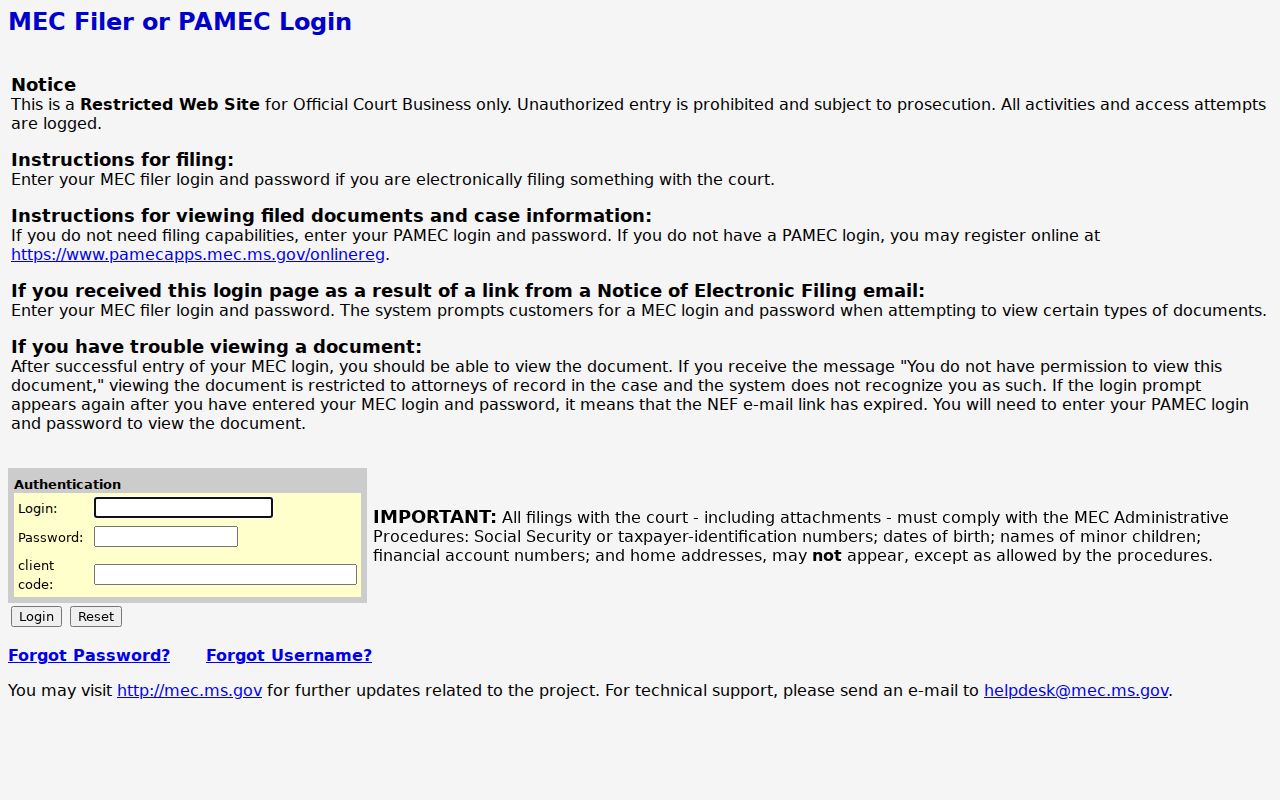
The login marks where authenticated access starts. It does not reveal the post-login search fields or guarantee a public document behind every case header.
Civil Docket Settings and Hearings
A docket setting is just a scheduled event. It might be a hearing, a status conference, or something tied to mediation. It is not a ruling and not a final outcome. A Quitman County docket entry may show a future date. Call the Chancery Clerk. Confirm the court, the time, and the purpose before you plan a trip or ask for records. The clerk posts no standalone live docket calendar for the county.
For statewide dates, the Mississippi Secretary of State's Judicial Directory and Court Calendar hub publishes court terms. It covers statewide dates. Those terms cover whole court periods. A listed day is no promise your case will be heard. PAMEC terms mention a calendar-events report. Its authenticated fields stay behind the login. For a specific civil hearing, the clerk's office beats any assumed online calendar field.
Setting check: A reset, continuance, mediation marker, or future hearing line does not decide the case. Read the dated docket entry and confirm the specific event with the court when details matter.
Quitman County Civil Docket Account Setup
PAMEC registration starts with user-type choices and personal account details. Only after that does a user reach any authenticated court search. The public pages show the sign-up steps, including registration controls and payment, but the post-login civil search interface itself sits behind the account. So treat what you can see as a map of the access process, not a preview of the search form or its results.
The PAMEC registration information form shows the account-information stage of that public access process.
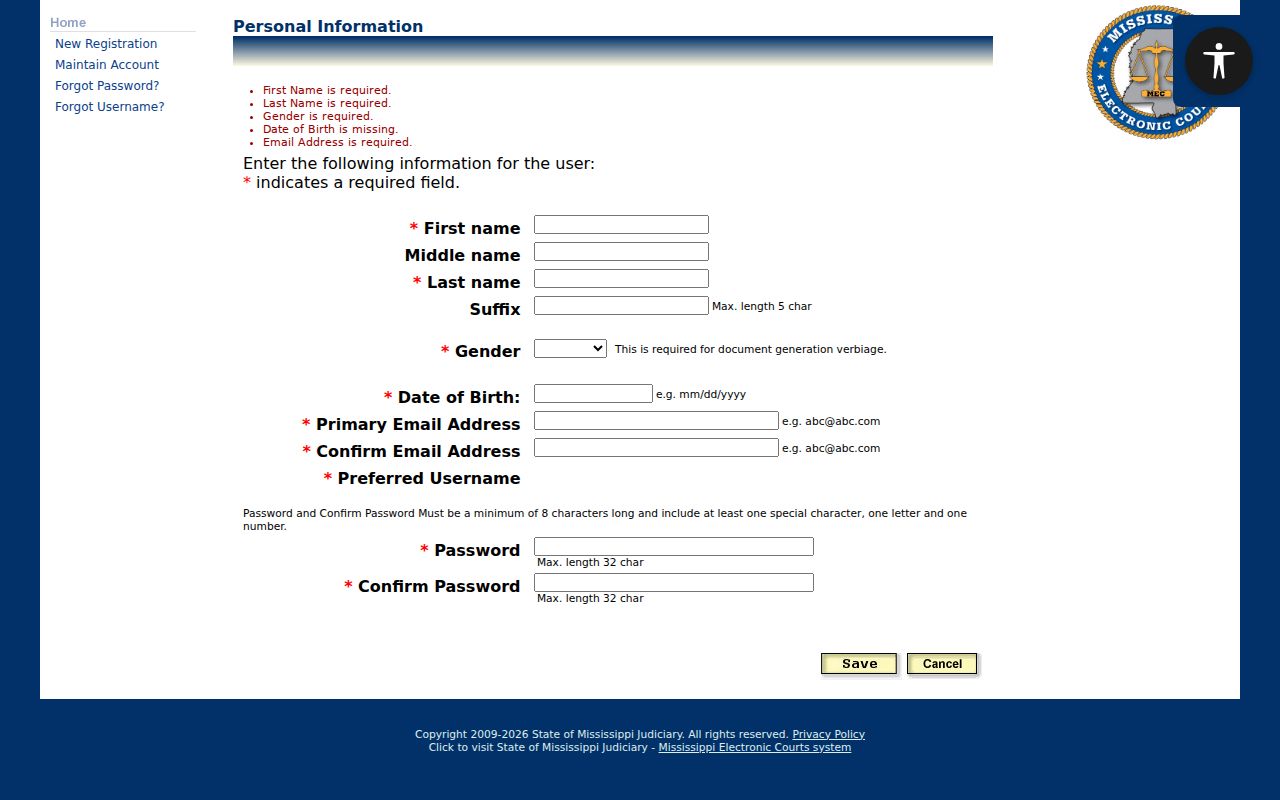
The form makes the order plain: account creation comes first, then electronic access. Register only on official PAMEC pages, and bring any case-file access question straight to the clerk. The PAMEC payment-method form shows the payment stage tied to an online account.
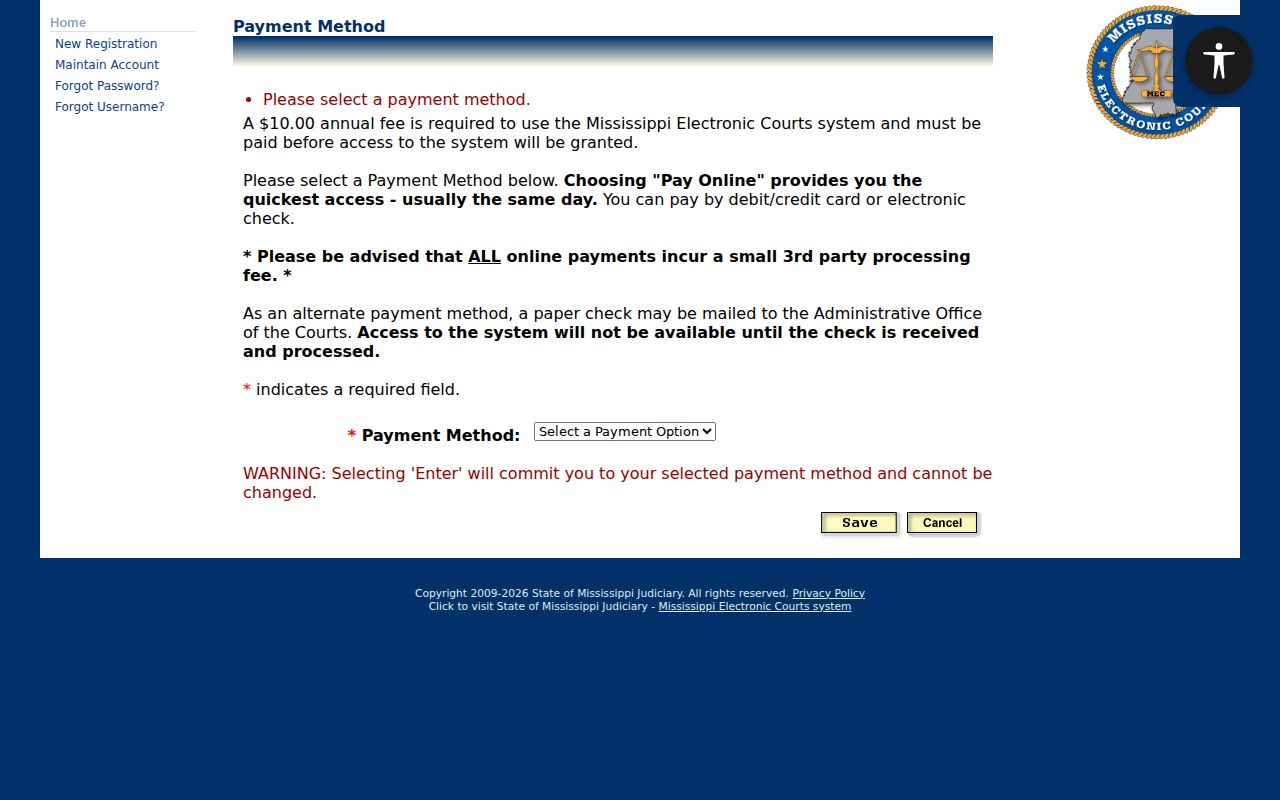
That payment screen is part of the account-access sequence, nothing more. It does not set what the clerk charges for a certified copy. For a clerk-certified document in Quitman County, ask the Chancery Clerk for a current quote.
Civil Docket Access Rules
Mississippi's Public Records Act sits at §§25-61-1 et seq. It covers public bodies. Court records work differently. MEC's privacy policy says the judiciary is not governed by the Act the way executive or local agencies are, so for a docket, pleading, or order, start with the clerk and the applicable court or MEC policy rather than a statutory deadline. No general public-record clock applies to a Chancery file.
For public users, PAMEC's non-attorney terms allow viewing of electronic documents, docket sheets, and notices in nonrestricted cases at adopting courts. The billing is straightforward: a $10 annual account fee, plus $0.20 per returned page, even when a search returns no match. Viewing a document online is not the same as holding a certified copy. Name the case and document when you request certification, then ask the clerk about access, fees, redaction, and delivery. The PAMEC non-attorney terms page states these public-user access and billing conditions.
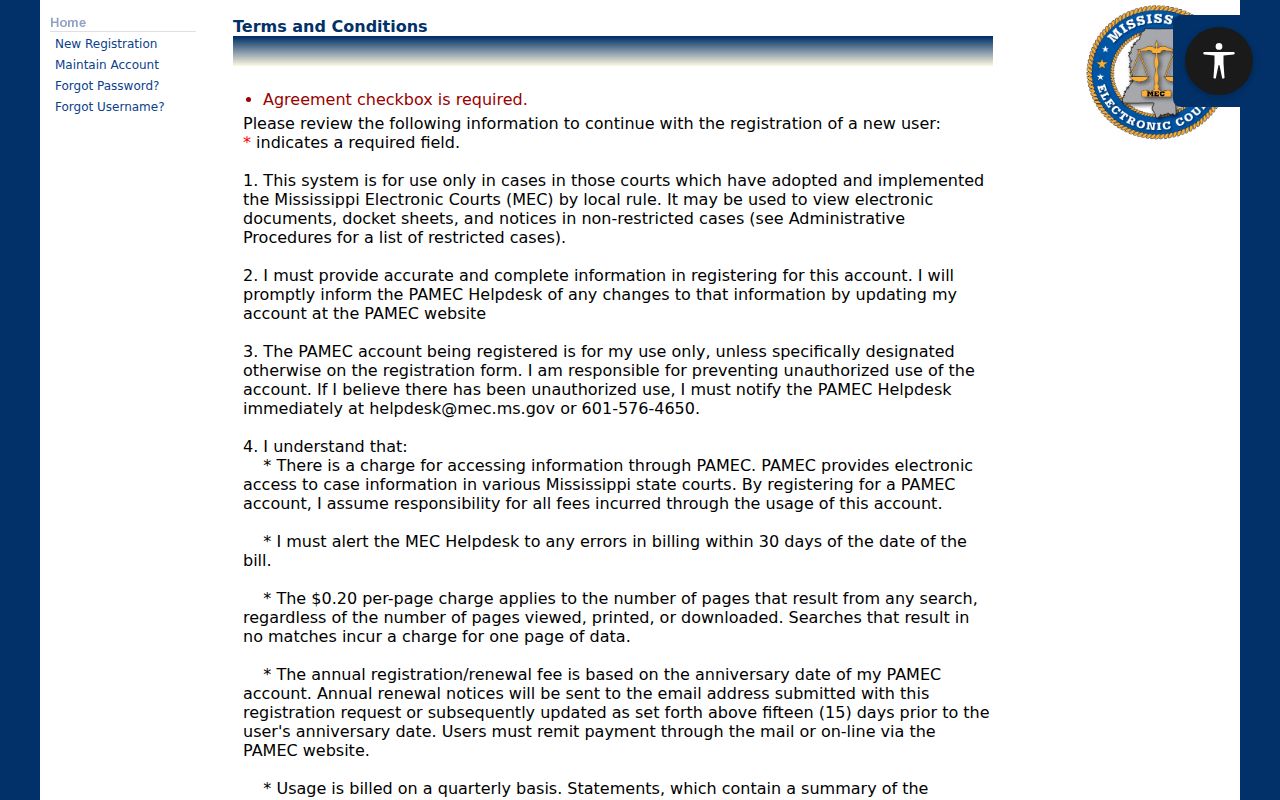
The terms price a narrow search plainly, and they mark where public access stops: court rules and policy can restrict any document.
Access boundaries:
Mississippi Public Records Act guidance covers the general state public-record framework.
MEC privacy policy describes the judiciary-specific rule distinction.
PAMEC terms identify non-attorney page billing and limited public viewing.
Quitman County Civil Docket Land Route
The Chancery Clerk handles both court cases and land records, but a deed is not a court pleading. Figure out what you actually need before you ask. Is it a recorded instrument like a deed, a Chancery complaint, an order, an estate filing, or a docket sheet? Each series may be indexed and reached in its own way. Even so, the same office serves as the local contact for Quitman County court records.
Quitman County Chancery Court sits at 220 Chestnut Street, Suite 2, Marks, Mississippi 38646. It is reachable at 662-326-2661, with regular hours of 8:00 a.m. to 5:00 p.m. The Quitman County court systems directory offers a local starting point for the court offices. Call ahead for anything sensitive, older, or certified. When you do, give the court, the case number, the document name, its date, and whether you need a certified or ordinary copy. Leave out child or financial details nobody needs.
The county offers no written request form of its own. MEC procedures describe free electronic viewing at a clerk's office during regular hours where policy permits. That does not guarantee free copies, remote access, or a look at restricted material. Ask whether in-person viewing is available. Get the current copy or certification fee before you send any payment.