
Searching the Quitman County Court Docket
Start with the paper in front of you. That single sheet usually tells you which Quitman County court holds the docket. Felonies and larger civil cases sit in Circuit Court. Divorce, estate, guardianship, land, trust, and custody matters run through Chancery Court instead. County misdemeanors, limited civil claims, and preliminary matters land in Justice Court. A city traffic ticket or ordinance violation starts in the municipal court printed on the citation. The Quitman County court-systems directory is the official local map to those offices. It lists no separate county court. Hunting a "County Court" docket in Quitman County only leads people astray.
Some Circuit and Chancery cases can be reached online through Mississippi Electronic Courts. Account access comes only after you set it up. Even then, the docket stays a court record. It is not a guarantee that every field or document opens from your kitchen table. Copy the court name, the case or citation number, a date, and the party name. Take each exactly as printed. Those exact details let a clerk pull the right Quitman County record when an online result is missing, restricted, or simply too broad.
- Read the court name on the citation, summons, notice, or prior Quitman County filing.
- Choose Circuit, Chancery, Justice, municipal, or federal before starting a name search.
- Use the official electronic route for participating Circuit or Chancery cases, after reviewing its account terms.
- Match the court, number, date, and case type before treating a Quitman County docket result as the right matter.
- Call or visit the clerk for a restricted, legacy, certified, or uncertain Quitman County court record.
Note: A town name alone will not do. Crenshaw and Crowder both extend across county lines, so confirm the county before you search.
Quitman County Docket Doors
One county, several doors. Circuit and Chancery use separate CourtInfo routes and carry different electronic histories. Justice Court keeps its own lower-court files on hand. Marks, Lambert, Crenshaw, Crowder, Sledge, and Falcon each run a municipal court for city matters. Federal cases tied to Quitman County go through the Northern District of Mississippi. Those run on PACER. The Mississippi Bar court-structure explanation lays out the statewide jurisdiction picture, yet the court named on your actual paper is what picks the Quitman County route.
- Circuit Court
- Quitman County’s general-jurisdiction path for felonies, larger civil cases, and certain lower-court appeals.
- Chancery Court
- The Quitman County court route for equity, domestic relations, probate, guardianship, trusts, and related matters.
- Justice Court
- A limited-jurisdiction Quitman County court for specified civil, misdemeanor, and preliminary proceedings.
- Municipal court
- A city court for local ordinances, city traffic, and other authorized municipal matters.
- Docket sheet
- A chronological case-activity record, not necessarily every filed document or a certified copy.
Quitman County’s official government site handles the county side of things. Notices and office routing live there. Think of it as a first stop. A real docket search still runs through the clerk.
Start with the county’s home page before you go digging for Quitman County court records. It points you to the right office. It cannot confirm a docket entry or replace a case lookup at the clerk’s counter.

County navigation helps you name the right office. Still, the court printed on the record itself remains the key to any Quitman County court docket.
Inside a Quitman County Court Docket
A Quitman County court docket lists procedural events in date order. The case header or docket sheet may show the court, the case number, the type of matter, the filing date, and the parties or caption. Public rules set what appears. The court and your access level matter too. Entry dates, hearing settings, status, and document links may appear as well. The PAMEC public pages show no live docket before login. Exact field labels, drop-downs, and result screens should not be assumed from the login screen.
Some items stay access-limited. A visible case header does not mean an attachment downloads. A flag such as SEALED, EXPUNGED, Minor_Child, or TRUST raises an access question. It is not a public finding about anyone. For a Quitman County docket, the dated entry and any order tell you more than a short system flag.
| Court and number | Identify the Quitman County court that controls the file and its case number if one is available. |
|---|---|
| Case header | Basic public metadata may include type, filing date, caption, or status, subject to the access level. |
| Docket entries | Chronological filings, events, notices, and orders, rather than a narrative summary of the case. |
| Settings | Scheduled court events that must be confirmed because they can move, be removed, or be confidential. |
| Documents | Electronic attachments may be unavailable, chargeable, redacted, sealed, or held only by the clerk. |
| Disposition | A court outcome shown by the authorized record, which is different from a future hearing setting. |
Quitman County MEC Access
PAMEC is Mississippi's public-access environment for participating electronic courts. The registration route offers attorney, non-attorney, and firm-administrator account choices. Non-attorney terms list a $10 annual account fee. Pages returned from a search cost $0.20 each, including a one-page charge when a search returns no match. That pricing makes a narrow Quitman County search smarter than repeated broad name searches. Online payment can carry processing costs, and mailing a check slows access down.
Public users may view docket sheets, notices, and electronic documents in nonrestricted cases. That applies to courts that have adopted MEC. Automated or abusive collection is prohibited. So PAMEC is an access channel, not a complete all-courts index. Justice Court and municipal searches have no official public online interface. Federal dockets belong in PACER. The PAMEC's official registration page shows the account boundary before a Quitman County electronic docket search begins.
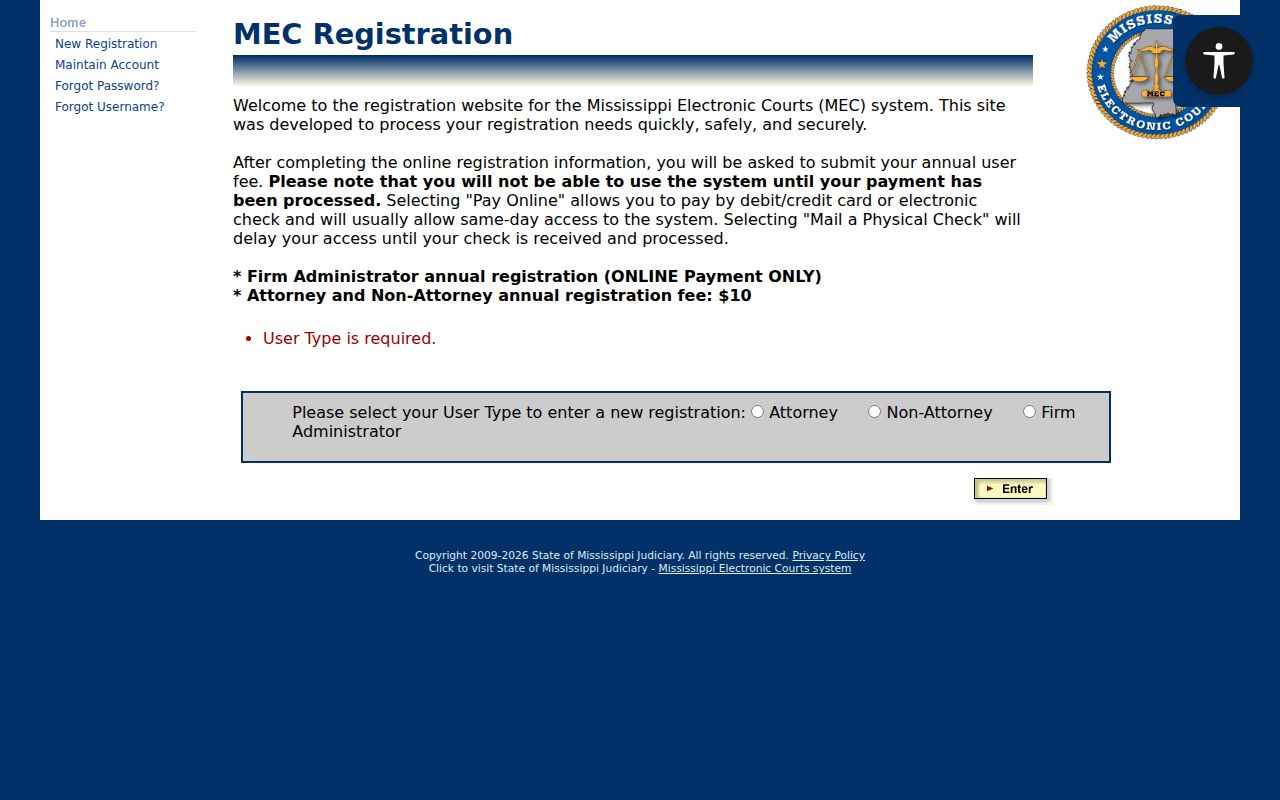
The registration screen documents access choices and fees. It is not a live Quitman County case result or a list of search fields.
Courts That Keep Dockets in Quitman County
Quitman County records split by jurisdiction. Circuit Court belongs to the Eleventh Circuit Court District. Chancery Court sits in the Seventh Chancery District. Justice Court has two listed districts, and each incorporated town runs its own municipal court for city matters. A federal matter connected to Quitman County can land in the Northern District of Mississippi. The table sorts the usual starting points, though the notice, citation, or case number can override a broad label such as "civil" or "traffic."
| Court | Docket covers | Where to search |
|---|---|---|
| Quitman County Circuit Court | Felonies, larger civil actions, and assigned appeals | Eleventh Circuit MEC/PAMEC route or Circuit Clerk |
| Quitman County Chancery Court | Domestic relations, estates, guardianships, land, trusts, and equity | Seventh Chancery MEC/PAMEC route or Chancery Clerk |
| Quitman County Justice Court | Limited civil matters, misdemeanors, preliminary proceedings, and county justice cases | Justice Court Clerk and the citation or summons |
| Municipal courts | City traffic, ordinances, and local municipal matters | The issuing town or municipal court named on the citation |
| Northern District of Mississippi | Federal cases | PACER and the federal court’s case-information route |
The county’s court-systems page identifies the local Circuit, Chancery, and Justice routes.
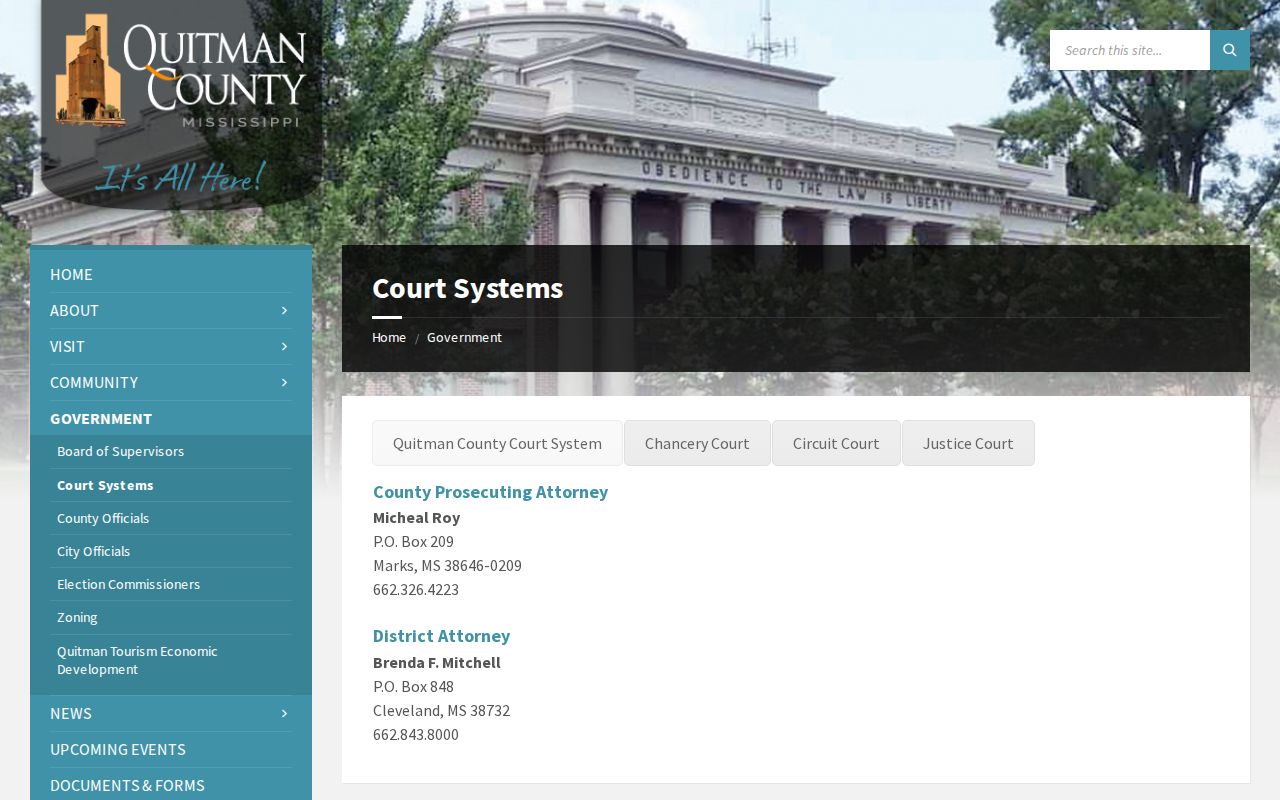
The official directory works as an office map for a Quitman County court docket request. It is not a public case database.
Quitman County Court Date Choices
Every Quitman County court date is set by a particular court. The calendar follows that court. The Secretary of State’s Judicial Directory and Court Calendar covers court terms statewide. It is also the home for directory information. It is not a live Quitman County hearing calendar, though. PAMEC terms point to a calendar-events report, but the public does not see its authenticated fields. When you need one specific setting, call the clerk. Bring the court, case number, case type, date range, and judge if you know it.
Ask the clerk about the Quitman County matter. Is it set, continued, passed, removed, confidential, or waiting on some other action? A calendar entry never proves a hearing actually happened. A date on a notice can also shift before the session. So the clerk stays the reliable route. That holds even with a terms publication or an electronic account in hand.
Note: Confirm any Quitman County hearing date before you travel. A term calendar is not a live courtroom docket.
How to Find Court Dates and Settings
For Circuit and Chancery settings, check the official electronic route first. The Quitman County clerk then confirms dates. Circuit Court’s CourtInfo page places that office in Suite 4 at the courthouse. Chancery sits in Suite 2. Justice Court and city court settings belong with the lower court named on your paper. Call first before relying on mail, fax, or email. A general calendar-request channel is not guaranteed. A phone call can save a missed filing or appearance. The Eleventh Circuit CourtInfo page is the official Quitman County Circuit Court electronic route and contact record. It shows the office location, contacts, and how the court’s online access works.
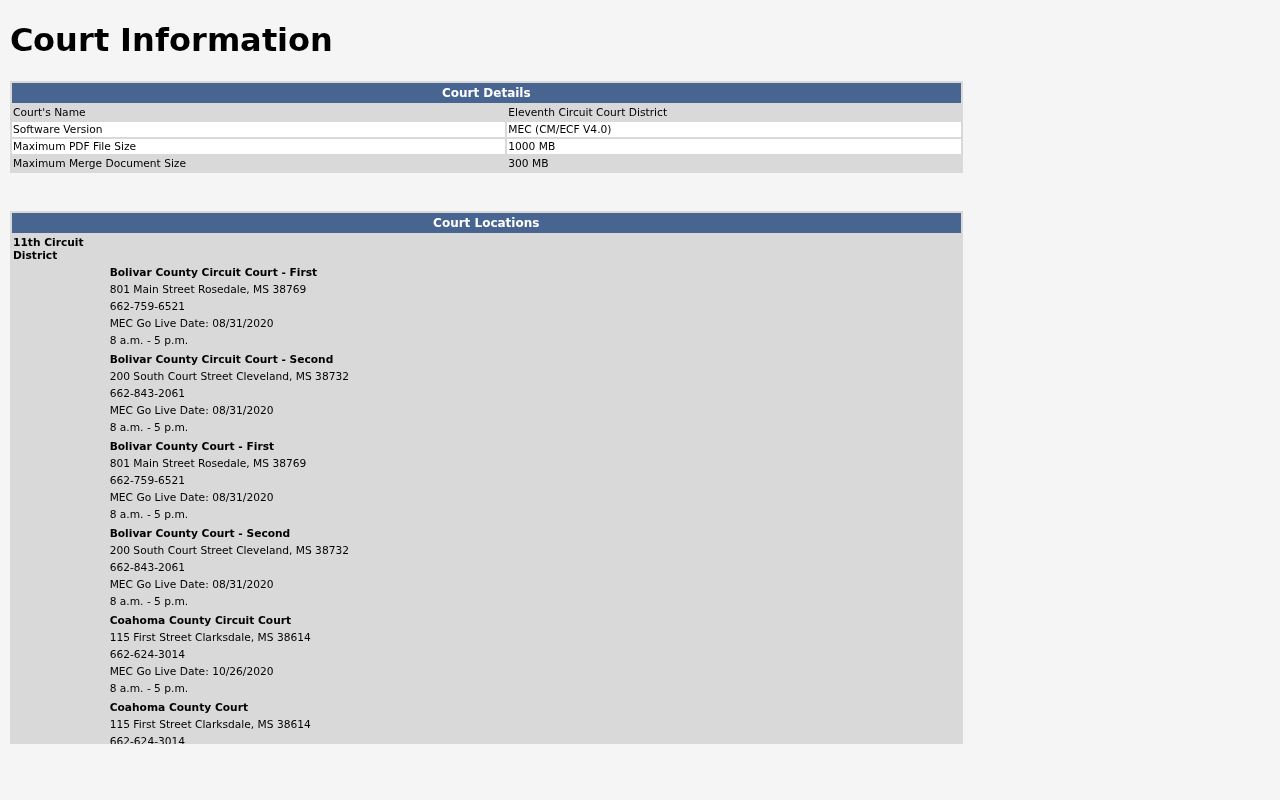
That CourtInfo page confirms the court route and office details. A specific Quitman County setting still takes a call to the court.
Quitman County MEC Dates
Two dates shape Quitman County’s electronic coverage. The Seventh Chancery CourtInfo page lists February 13, 2017 as Chancery’s MEC go-live. The Eleventh Circuit page gives April 22, 2024 for Circuit Court. That gap explains why a newer Quitman County Circuit docket may sit on a different online path. An older Circuit file may not sit there at all. Neither date promises that every later filing is available remotely. Neither means an older record never existed.
Legacy case labels, paper files, scanning limits, restrictions, and court rules all shape what the public can reach. Ask the Quitman County clerk directly about any single record. Is it electronic, legacy, archived, or open for public inspection? History is a clerk question. Do not guess a case result from a no-match. The Seventh Chancery CourtInfo page records the Quitman County Chancery electronic-court route. It includes contacts and system details.
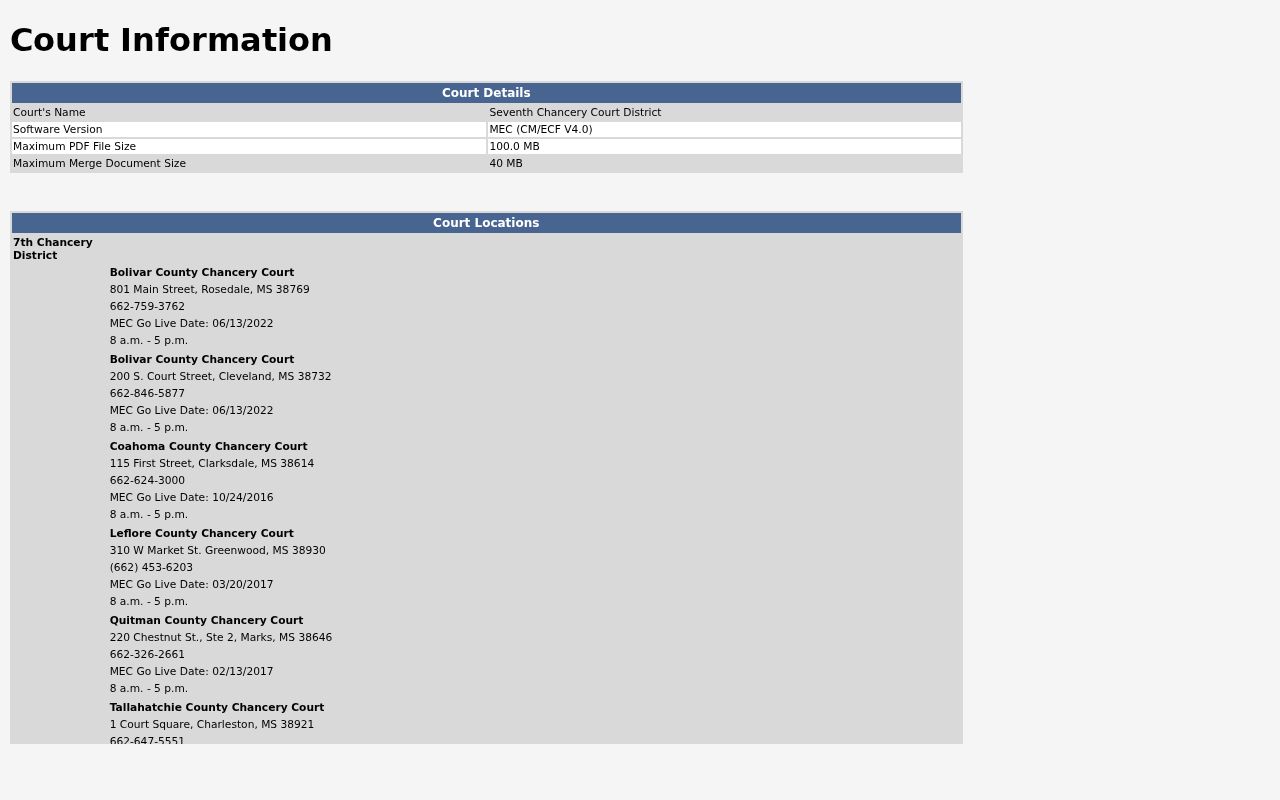
Chancery CourtInfo supplies court and system facts. It does not display any one Quitman County docket.
Public Access to Court Dockets
Mississippi’s Public Records Act opens many records held by public bodies. A Quitman County court file takes a more careful path. The MEC privacy policy notes that the judiciary is not subject to the Act. Executive or local administrative bodies are treated differently. Court access instead follows Supreme Court policy and each court’s own rules. So start with the right Quitman County clerk. Ask there for a docket, a pleading, or a certified copy. For a nonjudicial county administrative record, the Public Records Act is the more direct route.
Mississippi access rules:
Mississippi Public Records Act, §§25-61-1 et seq. explains the public-body request framework.
Miss. Code §25-61-5 addresses public access and denial rules for covered public bodies.
Miss. Code §25-61-7 addresses fees for covered requests.
Miss. Code §25-61-11 addresses exemptions and protected material.
Sealed, expunged, juvenile, and protected domestic-relations files stay out of public reach no matter how a request is worded. Restricted materials work the same way. And a missing Quitman County court docket result never proves a proceeding failed to exist.
Quitman County Court File Rules
Inspection, an ordinary copy, and a certified copy are three different products. MEC procedures describe free electronic viewing of civil and criminal documents at the clerk’s office during regular hours. That applies where access is permitted. The promise does not extend to a free remote copy, a certified document, or a sealed item. A Quitman County requester should ask whether a public terminal, staff-assisted search, or paper index exists. Ask as well whether a document needs redaction or a court order.
For court records, give the court, case number, date range, document, and whether you need certification. Ask the current fee, payment method, processing time, and accepted submission method. Do this before sending money or sensitive material. The clerk publishes no local request form or complete fee sheet. Confirm costs each time. The remote PAMEC per-page charge is separate from what the clerk charges for a certified copy.
Docket Records at the Clerk’s Office
Quitman County’s main Circuit and Chancery court access sits at the Marks courthouse. The county court directory names Circuit Clerk Teareathrea Keeler for Circuit Court. Chancery Clerk T.H. (Butch) Scipper serves Chancery Court. For a restricted file, a certified copy, or an uncertain filing route, a clerk is the best direct source. A paper or legacy index is a clerk question too. Justice Court runs from a separate office at 275 East Main Street. Municipal records stay with the town or court named on the citation.
Quitman County Circuit Clerk
220 Chestnut Street, Suite 4
Marks, MS 38646
662-326-8003
Quitman County Chancery Clerk
220 Chestnut Street, Suite 2
Marks, MS 38646
662-326-2661
The official county officials directory is the local cross-check for any Quitman County court docket request, listing current officials and their contact details.
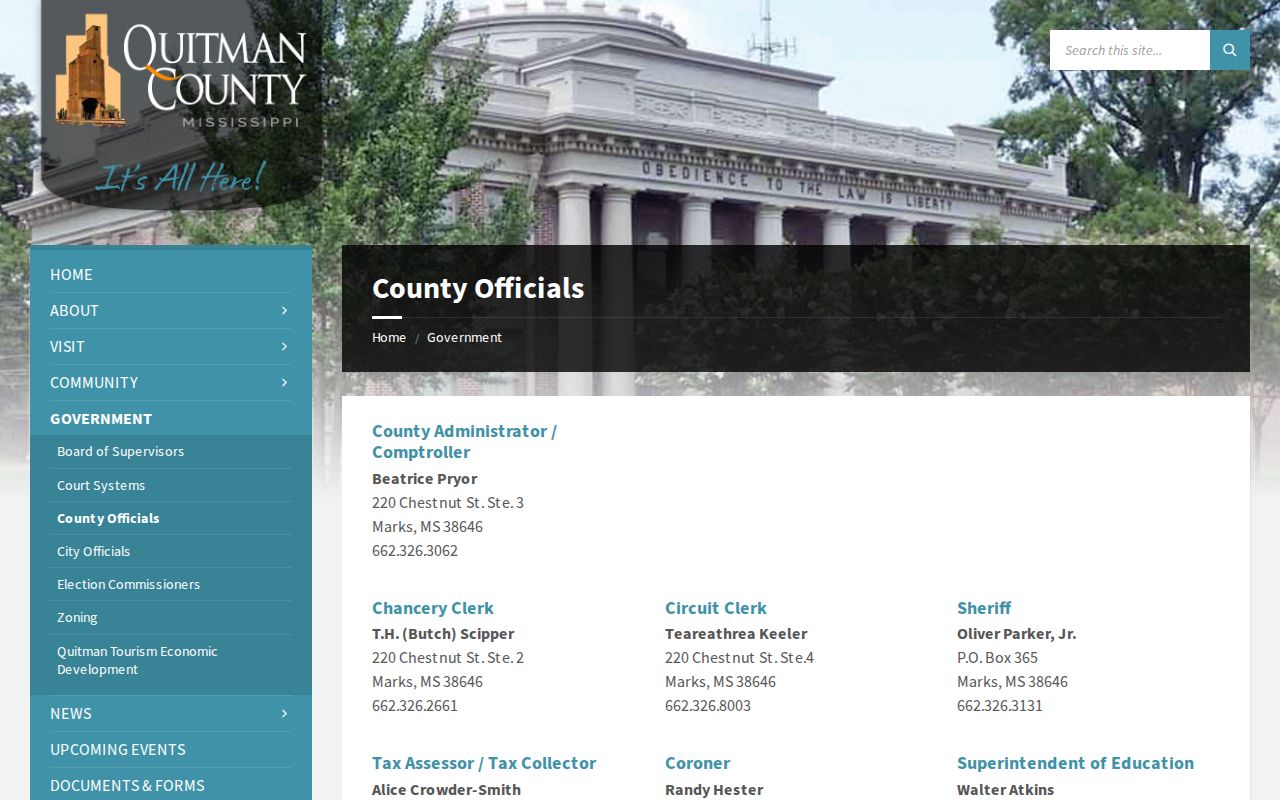
Directory names can lag behind different publication dates, so call before sending a time-sensitive Quitman County record request.
Quitman County Historic Court Records
Quitman County was created in 1877. A 1908 fire pushed courthouse operations out of Belen. The Marks courthouse that stands today was finished in 1911. That history shapes any search for an old Quitman County court record. Papers from early decades may sit in storage. They may be indexed under an older office system. Some show up in MEC only as a legacy reference. Old age alone does not put a case image online.
When you ask the Quitman County clerk about a historic land, probate, or court record, bring a date range and the record series. Ask what paper indexes exist and whether scanning is underway. Ask who actually holds the file. The Chancery Clerk routes many land and probate requests. A deed index and a pending court pleading can follow different access and copying paths. The Quitman County’s official history page lays out the courthouse and county timeline behind these records.
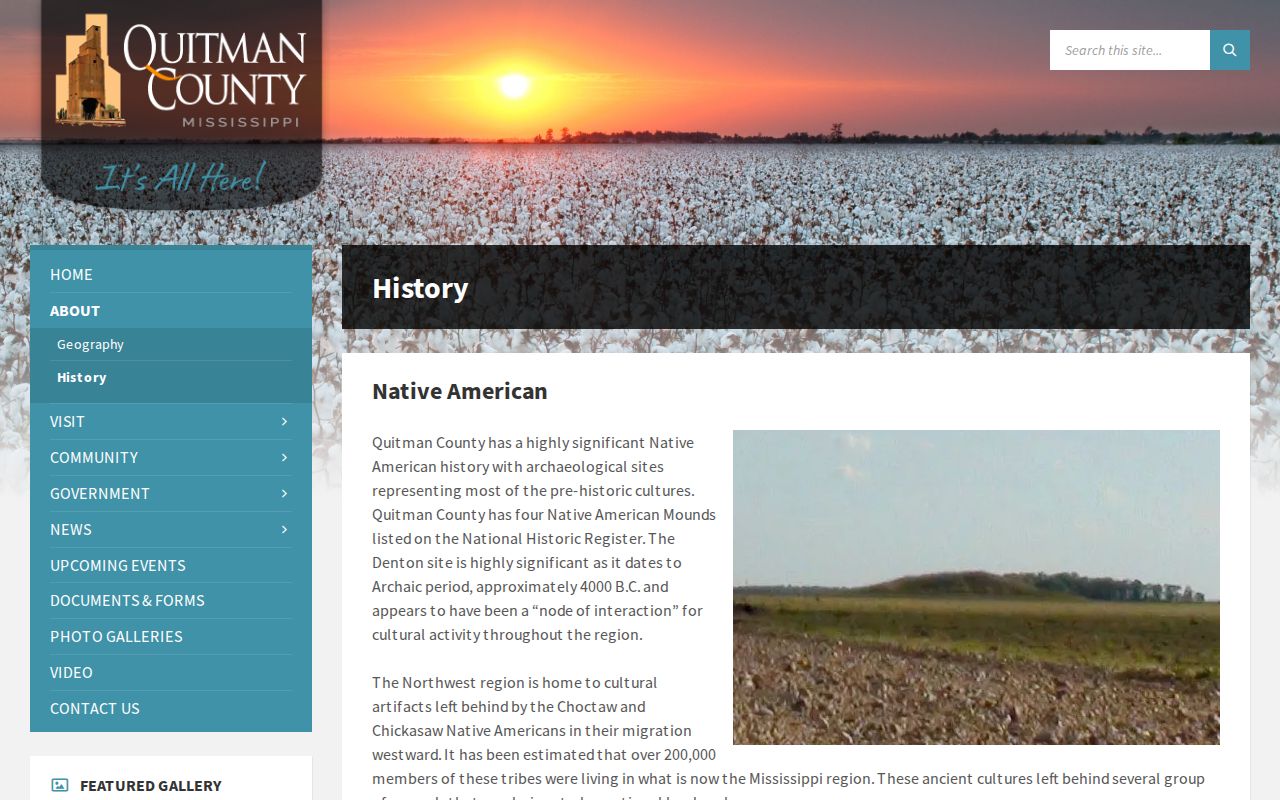
History frames the archive; the clerk decides what a Quitman County court record search can actually reach. The county courthouse page identifies the courthouse as the county access hub.
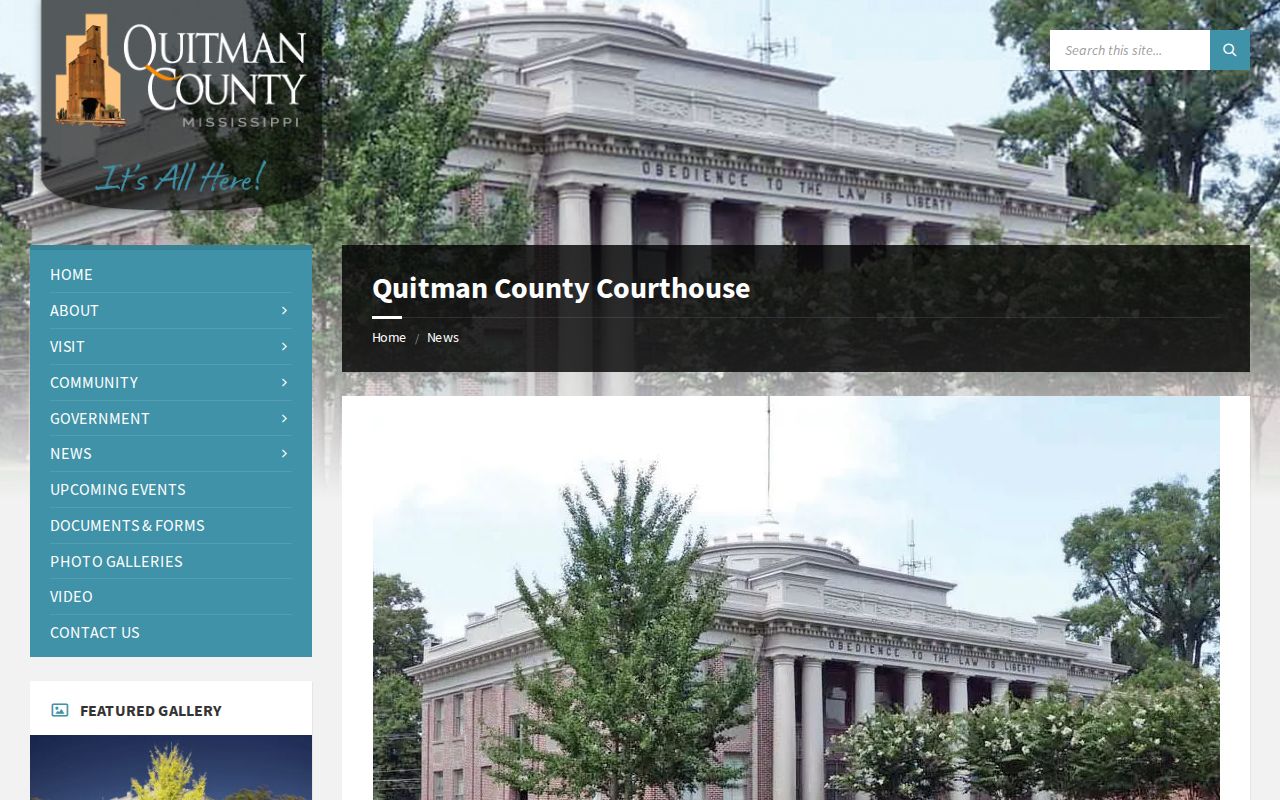
The courthouse anchors local access to court records. It does not mean every Quitman County court docket is online.
Quitman County Court Dockets by City
Quitman County has no single countywide docket covering its cities. Traffic tickets, ordinance violations, and other municipal matters start with the city court. That court is the one that issued them. Circuit, Chancery, and county Justice Court records each follow their own Quitman County routes. The Secretary of State’s 2024–2028 directory lists the five largest incorporated places. Those are Marks, Lambert, Crenshaw, Crowder, and Sledge. Crenshaw and Crowder both cross the Panola County line. So check the court name and citation location rather than trusting a town name alone.
Marks Docket Search
Population 1,444 · County-seat municipal records are separate from courthouse records.
Lambert Docket Search
Population 1,273 · Municipal citations start with Lambert’s court or office named on the ticket.
Crenshaw Docket Search
Population 638 · Cross-county status requires a close read of the issuing court.
Crowder Docket Search
Population 573 · Town records can route to municipal, Quitman, or Panola custody.
Sledge Docket Search
Population 368 · Town Hall is the first published route for city matters.
Quitman County Court Search Routes
Check jurisdiction before you search, and many dead ends disappear. A Quitman County municipal or Justice Court matter does not land in MEC automatically. A state Circuit or Chancery case has no place in PACER. A federal matter tied to Quitman County sits in the Northern District of Mississippi, where PACER and CM/ECF handle the separate federal route. Read the court named on the document. That name, not the county label, tells you which system to try first.
Mississippi’s court-structure resource shows the statewide hierarchy for making that first routing call.
The state court map gives helpful context for Quitman County docket routing. For a federal file, PACER stays the separate search path.
Map and Directions to the Quitman County Courthouse
Circuit Court and Chancery Court both file at the Quitman County Courthouse, a Neoclassical building completed in 1911 and designated a Mississippi Landmark in 1990, at 220 Chestnut Street in Marks. The Circuit Clerk's counter is Suite 4 and the Chancery Clerk's counter is Suite 2, inside the same building. Both offices post hours of 8:00 a.m. to 5:00 p.m.
Quitman County Circuit Clerk
220 Chestnut Street, Suite 4
Marks, MS 38646
662-326-8003
Monday through Friday, 8:00 a.m. to 5:00 p.m.
Quitman County Chancery Clerk
220 Chestnut Street, Suite 2
Marks, MS 38646
662-326-2661
Monday through Friday, 8:00 a.m. to 5:00 p.m.
Justice Court is in a separate building about a block away at 275 East Main Street. No official source documents courthouse parking, security screening, or accessibility details, so call ahead of a time-sensitive visit.